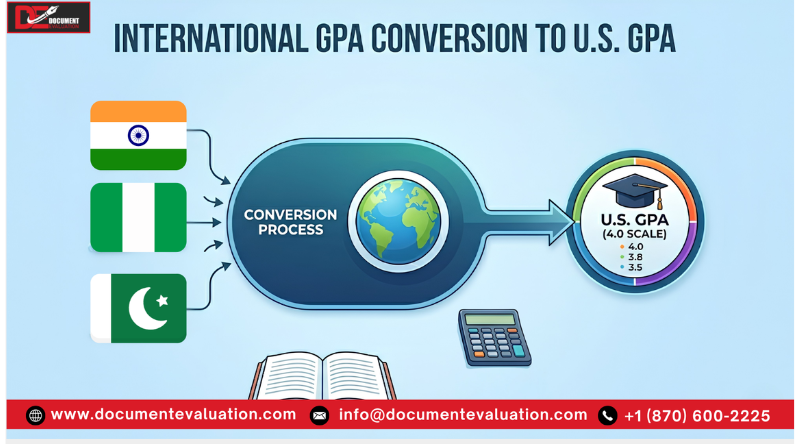
International GPA Conversion to U.S. GPA: Country-Based Methods and Practical Examples
By Admin April 8, 2026
0 Comments
Students applying to universities or jobs in the United States often need to present their academic performance in a familiar format. Since grading systems differ worldwide, converting international scores into a U.S. GPA becomes an important step. This article explains how GPA conversion works across countries, outlines practical methods, and highlights key points to ensure accurate interpretation.
Overview of the U.S. GPA Scale
The U.S. GPA system is based on a 4.0 scale, where letter grades correspond to numerical values. An “A” typically equals 4.0, a “B” equals 3.0, and so on. Some institutions also use weighted GPAs for advanced courses, but standard conversions usually rely on the unweighted scale.
Unlike many percentage-based systems, GPA reflects both grade quality and consistency. This makes direct comparisons with international systems more complex, as grading standards and distributions vary between countries.
Country-Wise GPA Conversion Methods
Conversion methods differ depending on how grades are structured in each country. Below are general comparisons:
India (Percentage System)
75–100% → 4.0 GPA
60–74% → 3.0–3.7 GPA
50–59% → 2.0–2.7 GPA Example: A score of 65% may convert to approximately 3.2 GPA.
United Kingdom (Honours Classification)
First Class (70%+) → 4.0 GPA
Upper Second (60–69%) → ~3.3–3.7 GPA
Lower Second (50–59%) → ~2.7–3.0 GPA Example: A 2:1 degree is often interpreted around 3.5 GPA.
Germany (1.0–5.0 Scale)
1.0–1.5 → ~4.0 GPA
1.6–2.5 → ~3.0–3.7 GPA
2.6–3.5 → ~2.0–2.7 GPA Example: A grade of 2.3 may equal roughly 3.1 GPA.
Canada (Letter/Percentage System)
A (85%+) → 4.0 GPA
B (73–76%) → ~3.0 GPA Example: A 78% score may convert to around 3.3 GPA.
These conversions are approximate and may vary by institution.
Steps to Convert International Grades to U.S. GPA
The process generally follows a few practical steps. First, identify your grading system and scale. Next, review whether the university you are applying to provides its own conversion guidelines.
If no official method is given, students often use credential evaluation agencies that standardize international transcripts. These agencies consider grading patterns, institutional reputation, and course difficulty.
Factors That Influence GPA Equivalency
Several factors affect how grades are converted. Grade distribution plays a major role; in some countries, high scores are rare, which changes how percentages are interpreted.
Academic rigor is another factor. Advanced or honors-level courses may be evaluated differently. Institutional policies also matter, as universities may apply their own conversion standards instead of general charts.
These variables explain why two students with similar percentages from different countries may receive different GPA equivalents.
Common Errors in GPA Conversion
One common mistake is applying a direct mathematical formula, such as dividing percentages by a fixed number. This approach ignores differences in grading systems.
Another issue is relying on unofficial online calculators without verifying their methodology. These tools may not reflect how universities actually evaluate transcripts.
Students also sometimes overlook official requirements, submitting self-calculated GPAs when certified evaluations are expected.
Situations Where GPA Conversion Is Required
GPA conversion is typically required for admission to U.S. universities, graduate programs, and scholarship applications. It may also be needed for professional licensing or employment evaluations.
In some cases, institutions handle the conversion internally. However, applicants are still expected to understand how their academic performance compares within the U.S. system.
Conclusion
International GPA conversion involves interpreting academic results across different grading systems rather than applying a single formula. Country-specific methods, institutional policies, and academic context all influence the final GPA equivalent. Using reliable guidelines and official evaluation resources helps ensure that academic records are presented accurately and fairly.
Education Credential Assessment: Your gateway to seamless credential evaluations, academic assessments, Request for Evidence assistance, and expert opinion letters for a smooth move to the USA.